



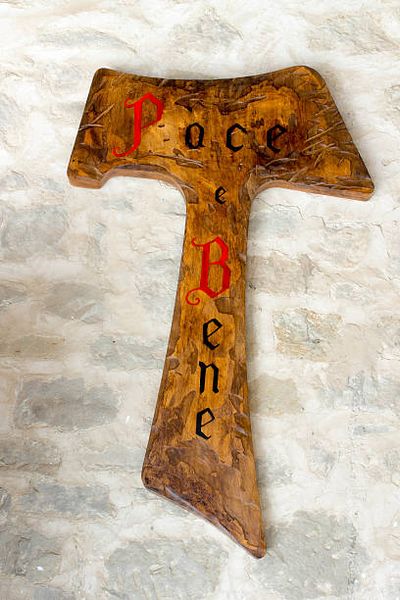




When St. Francis of Assisi died in 1226, fears that his body would be stolen meant that it was placed in an iron cage and buried so deep beneath the Basilica in Assisi, Italy, that his whereabouts remained a mystery for 600 years. He was famous for his miracles and his holiness but the reason that Francis’s body was hidden was what it contained. Two years before his death, it is said that Francis experienced a vision of a crucified seraphim, a six-winged angel, which marked his body with the stigmata – the wounds of the crucified Christ. This is the first recorded case of stigmata. Medieval sources tell us that, unlike later stigmatics, Francis did not just have holes in his hands and feet; he had growths resembling nails.
Numerous efforts to locate St. Francis’ body over the centuries all failed. In 1818, excavations deep within the Basilica’s foundations finally revealed the iron cage and the simple coffin containing the saints’ bones. These were examined by both ecclesial and scientific authorities and both affirmed their authenticity. The last time the bones were examined was in 1978, when they were placed inside a nitrogen filled plexiglass box to aid their preservation. An underground chapel was constructed to allow pilgrims to see St. Francis tomb, though not the bones themselves. To commemorate the 800th anniversary of his death, known as the Transitus, St. Francis’ remains will go on extended display for the first time. In addition, Italy has established October 4, 2026 as St. Francis Day and declared it a national public holiday.
2026 is the Year of St. Francis, marking his passing some 800 years ago. Pope Leo XIV has declared this Jubilee Year as one of reflection on St. Francis’ great humility and love of the poor and sick; the least among us. In response to the Holy Father’s proclamation, the Archdiocese of Atlanta, has identified Jubilee pilgrimage locations at local Franciscan parishes, shrines, missions and communities dedicated to St. Francis for the faithful to obtain a plenary indulgence. Our parish is one of those designated locations. To read more about the indulgence offered, please click the picture above!
Please note that the Shrine of the Most Blessed Sacrament in Alabama is also a pilgrimage site for those of you visiting with the Adoration Sodality this October.
The Church traditionally dedicates the month of March to the special veneration of St. Joseph, whose feast day is March 19th. “He was chosen by the eternal Father as the trustworthy guardian and protector of His greatest treasures, namely, His divine Son and Mary, Joseph’s wife.” Due to St. Joseph’s leadership of the Holy Family, he has been declared the protector and patron of the universal Catholic Church.
Key Details About the Feast Day on March 19:
Did You Know?
The Franciscans and the Poor Clares, started by St. Francis of Assisi and St. Clare of Assisi in the 13th century, were both profoundly devoted to the Most Blessed Sacrament. St. Clare, the first female disciple of St. Francis, founded the community originally known as the Poor Ladies of Assisi in the monastery of San Damiano. The Poor Clares of Perpetual Adoration are a branch of the Poor Clares of France who follow the Franciscan traditions begun by St. Clare. They are a group of cloistered nuns dedicated to perpetual adoration of the Blessed Sacrament. The Poor Clares in Alabama were started by Mother Angelica in 1962. 800 years of Adoration! All the way from 13th century Italy to 20th century Alabama.